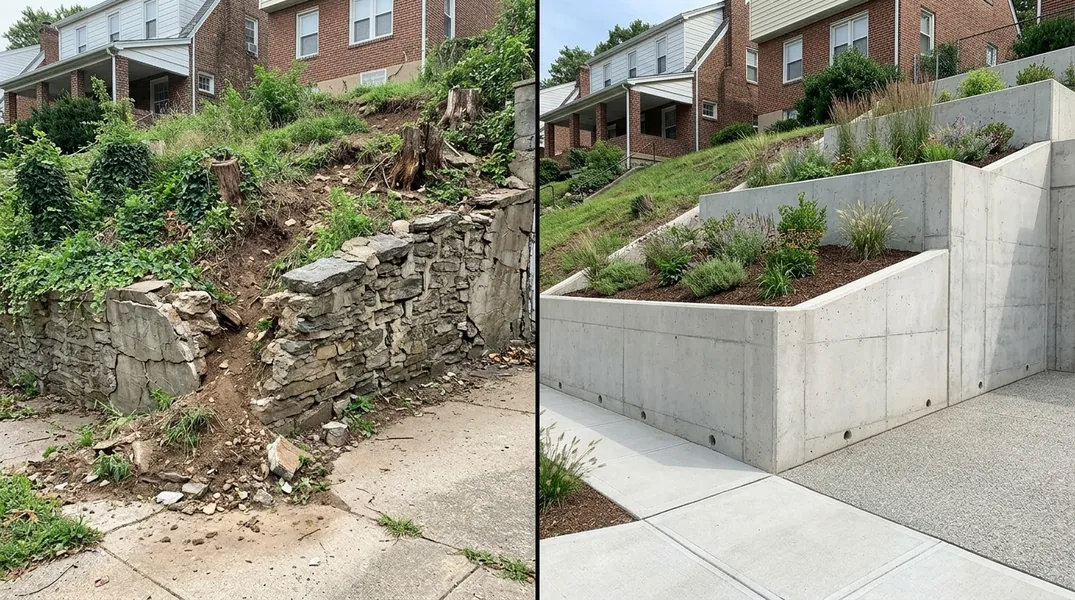
Understanding Philadelphia's Unique Soil Challenges
Philadelphia homeowners with hillside properties face distinct soil and geological challenges that directly impact retaining wall performance. The region's composition includes dense clay layers, fill soil from historical development, and exposed schist bedrock, all of which require different engineering approaches. When water infiltrates these soil types, clay expands and contracts seasonally, fill soil can settle unevenly, and schist creates drainage complications that put pressure on poorly designed walls.
These soil conditions mean that choosing the right retaining wall material isn't just about aesthetics or budget. It's about selecting a solution that will handle decades of freeze-thaw cycles, seasonal moisture fluctuations, and the specific loading pressures unique to your lot. A wall that works perfectly in sandy soil may fail in Philadelphia's clay-heavy terrain. Understanding your soil type is the first step toward a retaining wall that will protect your property investment for years to come.
Concrete Retaining Walls: Durability and Strength
Concrete Retaining Walls are a popular choice for Philadelphia properties because they offer exceptional strength and longevity in challenging soil conditions. Poured concrete walls can be engineered to exact specifications, making them ideal for properties with complex drainage needs or high lateral pressure from clay and fill soils. The monolithic nature of poured concrete means there are no joints where water can infiltrate and cause failure over time, which is a significant advantage in a region that experiences substantial seasonal rainfall.
The main consideration with concrete walls is initial cost and installation complexity. Concrete requires proper formwork, reinforcement design, and curing time, which means the pricing tends to be higher than some alternatives. However, when you factor in the minimal maintenance requirements and the wall's ability to withstand Philadelphia's clay soils without shifting or cracking, the long-term value becomes clear. Concrete walls typically require no repairs for 30 to 50 years when properly installed with adequate drainage, making them an excellent investment for serious hillside stabilization.
Segmental Retaining Walls: Flexibility and Installation Speed
Segmental retaining walls, also called modular block walls, have become increasingly popular for residential Retaining Wall Installation projects throughout the region. These walls are constructed from interlocking concrete blocks or similar units that are stacked and backfilled, creating a system that's remarkably flexible and forgiving in variable soil conditions. The flexibility is actually an advantage in Philadelphia's clay and fill soils, because the wall can accommodate minor settling without cracking catastrophically like a rigid concrete wall might.
One of the biggest benefits of segmental retaining walls is the speed of installation. There's no waiting for concrete to cure, no complex formwork, and no need for heavy equipment to pour massive foundations. This translates to faster project timelines and typically lower labor costs compared to poured concrete. The modular design also makes future Retaining Wall Repair or Retaining Wall Replacement easier, since individual blocks can be removed and replaced without affecting the entire structure. For homeowners who want a balance of performance, cost-effectiveness, and construction speed, segmental block walls are an excellent option.
Boulder Retaining Walls: Natural Aesthetics and Drainage Advantages
Boulder retaining walls, sometimes called dry-stacked or mortared boulder walls, offer a distinctly natural appearance while providing surprisingly effective erosion control and soil stabilization. These walls are constructed from large, irregularly shaped stones that are carefully fitted together, either with or without mortar. In Philadelphia's schist-rich areas, using local stone creates a beautiful aesthetic that complements the region's natural geology while also supporting local material sourcing.
The drainage characteristics of boulder walls are particularly advantageous for clay and fill soils. The irregular surface and gaps between stones naturally promote water movement and prevent the buildup of hydrostatic pressure that can destabilize other wall types. This makes boulder walls especially suitable for hillsides where water management is critical. The trade-off is that boulder walls typically require more skilled labor to construct properly, and they work best for walls under 4 to 5 feet in height. For shorter slopes or decorative applications, boulder walls provide excellent performance and unmatched visual appeal that blends seamlessly with Philadelphia's landscape.
Block Retaining Walls: Versatility for Residential Properties
Block retaining walls represent a broad category that includes segmental concrete blocks, natural stone blocks, and composite materials. This versatility makes block walls one of the most popular choices for residential properties across Philadelphia and surrounding areas. Concrete block walls can be designed in various heights, finishes, and colors, allowing homeowners to match their landscape design while still achieving reliable structural performance in clay and fill soils.
The key advantage of block walls is the combination of structural integrity, aesthetic flexibility, and manageable installation costs. Unlike poured concrete, which requires significant upfront planning and formwork, block walls can be built relatively quickly with straightforward construction techniques. The individual units also provide some of the flexibility benefits of segmental walls while offering the solid construction quality that Philadelphia homeowners expect. Whether you're building a new wall or considering Retaining Wall Replacement, block systems offer proven performance across the region's diverse soil conditions.
Choosing the Right Material for Your Philadelphia Hillside
Selecting the best retaining wall material for your specific property requires understanding three critical factors: your soil type, the wall height and slope angle, and your budget and timeline. A professional site evaluation can determine whether you're dealing primarily with clay, fill, schist, or a combination of materials. This assessment directly influences which wall type will perform best and require the least maintenance over time. Some hillsides benefit most from engineered concrete solutions, while others are perfectly suited to segmental blocks or natural stone.
The most important step is getting a professional evaluation from experienced installers who understand Philadelphia's specific geological and soil conditions. Philadelphia Retaining Wall specializes in assessing local hillside properties and recommending the optimal material and design for each unique situation. Whether your property requires the ultimate durability of poured concrete, the flexibility and cost-effectiveness of segmental blocks, the natural beauty of boulders, or the versatility of block systems, our team can guide you to the right choice. Contact us at (445) 278-5117 or request a free estimate to discuss your hillside stabilization needs and get a customized recommendation based on your soil conditions and project goals.
Looking for a professional retaining wall contractor in Philadelphia? Philadelphia Retaining Wall responds fast for all your retaining wall needs.
Get a Free QuoteOur services: Retaining Wall Installation · Retaining Wall Repair · Retaining Wall Replacement