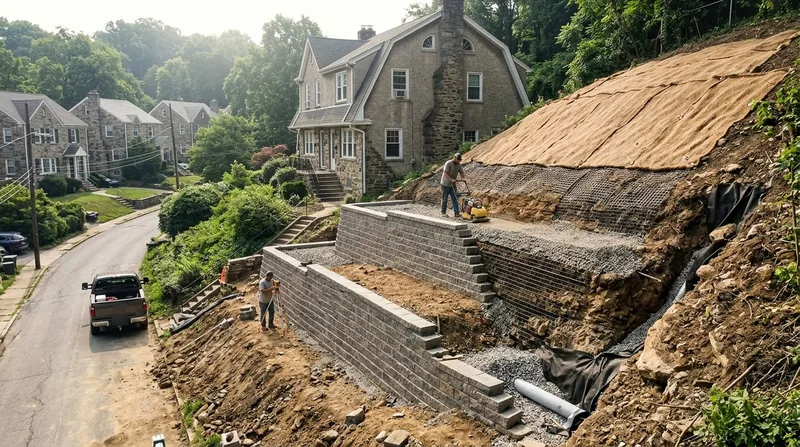




Slope Stabilization & Erosion Control in Philadelphia protects your home, driveway, and yard from the relentless forces of water and gravity that destabilize hillside lots across the region. Philadelphia's terrain splits sharply at the Fall Line: the northwest rises into rocky hills carved by the Wissahickon and Schuylkill valleys, where 1890s stone twins and rowhouses cling to steep terraced lots held by mortared schist walls and poured concrete. The southeast spreads flat across sand, silty clay, and old fill with a high water table near the Delaware. Freeze-thaw cycles, summer cloudbursts, nor'easter rain, and poor drainage clog weeps and topple walls year after year. We stabilize slopes with terraced retaining walls, geogrid reinforcement, and engineered drainage to stop soil movement before it damages your foundation or driveway. Call (445) 278-5117 for a free estimate, or learn more about our retaining wall installation methods.
Why Slope Stabilization Matters on Philadelphia's Hillside Lots
Northwest Philadelphia's steep creek-valley lots, Chestnut Hill, Mount Airy, Roxborough, Manayunk, sit on exposed Wissahickon schist and glacial till that absorb winter snow melt and spring rain. Water infiltrates behind old mortared walls, frost heaves the footing, and soil creep inches your house downhill. In South Philadelphia and the Northeast, high water tables and decades of fill settle unevenly under rowhouse foundations and driveway cuts. Without active stabilization, soil erosion accelerates, wall cracks widen, and repair costs explode. We identify the root cause (poor drainage, inadequate wall height, missing geogrid) and rebuild your slope to hold it permanently.
- Terraced walls distribute load across multiple levels and reduce pressure on any single structure.
- Geogrid reinforcement locks soil in place and prevents lateral creep behind the wall.
- Subsurface drainage channels water away from the wall footing and stabilizes the soil above.
- Native plantings and erosion blankets slow surface runoff and bind topsoil on steep grades.
- Proper wall setbacks and property-line compliance keep neighbors and code officials satisfied.
Each of these methods works together to hold your slope stable through heavy rain, freeze-thaw cycles, and decades of settlement.
Key info: Philadelphia's Department of Licenses and Inspections (L&I) requires a permit for retaining walls above roughly 4 feet measured from the footing, or when a wall supports a surcharge such as a driveway or house addition. Engineered drawings are mandatory for tall or tiered walls. Always verify setback and property-line rules with your local building department before design begins. Visit phila.gov/licenses to confirm current thresholds.
How We Stabilize Your Slope: Our Process in Philadelphia
We start with a detailed site inspection to map soil type, water flow, existing wall condition, and property lines. We dig test pits to understand bearing capacity and identify seepage points. From that data, we design a tiered wall system with proper drainage, calculate geogrid requirements, and submit engineered plans to the building department if your wall exceeds permit thresholds. Once approval arrives, we excavate, set proper footing depth below frost line (typically 36 to 48 inches in Philadelphia), install perforated drain pipe behind the wall, build the wall to spec, and compact backfill in 6-inch lifts with geogrid every 2 to 3 feet. The result is a slope that sheds water, resists creep, and holds your property for decades.
- Site inspection and soil testing identify water sources, bearing capacity, and wall height needed to stabilize your lot.
- Engineered design calculates wall height, geogrid spacing, and drainage requirements specific to your soil and slope angle.
- Permitting submission to the Philadelphia or local building department ensures code compliance before work starts.
- Excavation and footing preparation set the wall base below frost line to prevent heave and settlement.
- Drain pipe installation behind the wall directs seepage to daylight or a storm drain, preventing hydrostatic pressure buildup.
- Wall construction and geogrid placement reinforce the soil and lock it in place against lateral movement.
- Backfill compaction and grading restore your yard and direct surface water away from the stabilized area.
This systematic approach transforms a failing slope into a stable, durable foundation for your home and landscape.
Real example: A Roxborough homeowner had a 30-year-old mortared schist wall leaning inward with water seeping from the joints. We excavated behind it, installed a new 3-tier SRW (segmental retaining wall) system with geogrid and perforated drain, and regraded the slope to shed water downhill. The job took 4 weeks, required a permit, and cost $18,500. The homeowner's basement stayed dry all winter, and the slope has not moved since. See our retaining wall drainage page for more details on water management.
Slope Stabilization Methods: What Works Best in Philadelphia
| Approach | Description | Best for |
|---|---|---|
| Segmental Retaining Walls (SRW) with Geogrid | Interlocking concrete blocks stacked with geogrid every 2 to 3 feet of height, creating a gravity wall that locks soil in place. | Slopes 8 to 20 feet tall, residential lots in Chestnut Hill and Mount Airy, high water tables, and freeze-thaw zones. |
| Poured Concrete Retaining Walls | Monolithic concrete cast in place with a stem wall, heel, and toe, engineered for high surcharge loads and tight property lines. | Steep grades, driveway support, and narrow yards where space for tiered walls is unavailable. |
| Multi-Tiered Terraced Walls | Two or more shorter walls stacked with benches between them, each with independent drainage and geogrid. | Very steep slopes over 20 feet, distributes load, reduces wall pressure, and allows terraced planting on benches. |
| Soldier Pile and Lagging | Steel H-beams driven deep into stable soil with wood or steel lagging boards spanning between them, tied back with tiebacks or anchors. | Deep excavations, high surcharge loads, and situations where traditional walls cannot be built tall enough. |
| Erosion Control Blankets and Native Planting | Biodegradable mats anchored over exposed soil with native shrubs and grasses to slow runoff and bind topsoil. | Gentle to moderate slopes, temporary stabilization during construction, and permanent vegetative erosion control. |
Each method is selected based on slope angle, soil type, water table depth, surcharge loads, and local code requirements. Our engineers choose the most cost-effective and durable solution for your specific Philadelphia site.
Slope Stabilization & Erosion Control Cost in Philadelphia: What to Expect
The cost of slope stabilization and erosion control in Philadelphia depends on wall height, slope length, soil conditions, drainage complexity, and whether an engineered design and permit are required. A simple 8-foot segmental retaining wall with basic drainage on a residential lot typically ranges from $8,000 to $15,000. A multi-tiered system with soldier piles and deep excavation can run $25,000 to $50,000 or more. We provide a free estimate after a site visit, which includes a walk-through, soil observations, preliminary measurements, and a realistic price range. This estimate is binding only if you choose to move forward, and we explain every factor that affects the final cost.
Several factors move the price up or down. Wall height is the primary driver: each additional foot of height increases geogrid, labor, and concrete or block costs. Soil type matters too: clay and fill require more robust drainage and deeper footings than stable bedrock. Access difficulty, proximity to utilities, and whether you need a building permit all add time and complexity. We recommend getting 2 to 3 estimates from licensed contractors so you can compare methods, timelines, and warranties. Visit our pricing page for more detail on cost breakdowns by wall type and size.
Most jobs are completed within 2 to 8 weeks depending on scope. Emergency slope failures or urgent drainage issues may be expedited with additional crew and equipment. Always ask your contractor about the warranty on the wall (typically 10 years on materials and workmanship) and whether soil stabilization or geogrid carries a separate guarantee.
Slope Stabilization & Erosion Control Near Me: What Philadelphia Homeowners Should Know When Hiring
Choosing the right contractor for slope stabilization near Philadelphia starts with verifying that they are licensed, insured, and bonded. Ask to see their Pennsylvania Home Improvement Contractor license and current general liability and workers' compensation insurance. A licensed contractor has passed a state exam, maintains a bond, and is subject to complaint and disciplinary action if they fail to deliver. Call the Pennsylvania Attorney General's office or check the Home Improvement Contractor Board website if you have questions about a contractor's standing. Request references from recent slope stabilization or retaining wall jobs in your area, and call at least two to ask about quality, cleanup, and how well the wall has held up.
Understand permit requirements before signing a contract. If your wall is over 4 feet or supports a surcharge, your local building department will require a permit and may ask for engineered drawings. A reputable contractor will handle the permit application and keep you informed of approval timelines. Ask whether the estimate includes permit fees and engineered design, or if those are add-ons. Get everything in writing: the scope of work, materials, timeline, payment schedule, and warranty. Do not pay the full amount upfront; typical terms are 30 percent down, 40 percent mid-project, and 30 percent on completion. If your property is in an HOA or historic district, check those rules before design begins; some require architectural approval or restrict wall materials and colors.
Finally, ask about emergency response. If your slope fails during a heavy rain or freeze-thaw cycle, you need a contractor who can mobilize quickly. We offer 24-hour emergency stabilization and can often assess and begin temporary bracing the same day. Call our contact page or phone (445) 278-5117 to request a free estimate or to report an emergency.
Slope Stabilization & Erosion Control in Philadelphia: Pricing Guide
| Service | Price | Details |
|---|---|---|
| Free Estimate | Free | Site visit, soil inspection, preliminary measurements, and realistic price range with no obligation to book |
| Simple Segmental Wall (8-12 feet tall, single tier) | Starting at $8,500 | Includes geogrid, basic drainage, excavation, and compaction; final price depends on slope length and soil conditions |
| Multi-Tiered Terraced System (15-25 feet total height) | Starting at $18,000 | Two or more walls with benches, comprehensive drainage, and engineered design; pricing reflects wall height and soil type |
| Poured Concrete or Soldier Pile Wall (high surcharge, tight space) | Starting at $25,000 | Engineered design, deep footing, potential tiebacks or anchors; final cost depends on wall height, excavation depth, and geotechnical requirements |
| Permit and Engineered Design | Included | in estimate for walls over 4 feet or with surcharge; submission and approval coordination handled by our team |
| Emergency Slope Failure Stabilization | On estimate | Same-day or next-day assessment and temporary bracing; permanent repair priced after emergency stabilization is in place |
Indicative pricing, the exact cost depends on square footage, finish, and site access. Free personalized estimate within 24h at (445) 278-5117.


