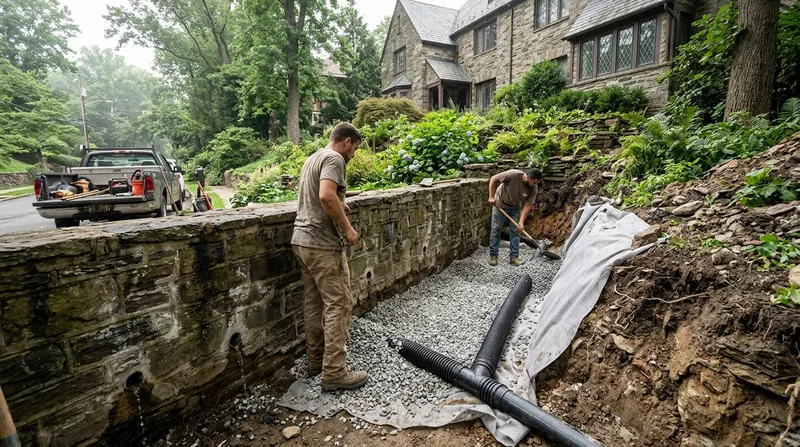




Philadelphia's retaining walls face a relentless enemy: water. From the steep, rocky terraces of Chestnut Hill and Roxborough, where Wissahickon schist walls have held hillsides for over a century, to the flat coastal-plain neighborhoods of South Philly with their high water tables and seasonal flooding, improper drainage is the single largest cause of wall failure in this region. Freeze-thaw cycles in winter, combined with heavy spring and fall rains from nor'easters, force hydrostatic pressure against wall faces and frost heave from below. Without proper retaining wall drainage in Philadelphia, even a well-built wall will eventually lean, crack, or collapse. We install and repair drainage systems that stop water before it destroys your investment, keeping walls dry, stable, and lasting decades longer than walls left to manage moisture on their own.
Why Proper Drainage Is Critical for Retaining Walls in Philadelphia
Water doesn't just sit behind a retaining wall, it accumulates and pressurizes. In Philadelphia's climate, spring snowmelt, summer cloudbursts, and the relentless humidity of late August create conditions where soil stays saturated for weeks. That standing water exerts enormous hydrostatic force on the wall face, pushing it outward. When winter arrives, that water freezes, expands, and heaves the wall upward and outward in a process called frost heave. Older timber and railroad tie walls in neighborhoods like Lansdowne and Media fail almost exclusively from this mechanism. Concrete and block walls crack and lean. Drainage systems relieve this pressure before it builds.
- We install French drains behind the wall to intercept groundwater and channel it safely away from the wall face.
- We drill or install weep holes through the wall itself to allow trapped water to escape and reduce backpressure.
- We specify proper gravel backfill and perforated pipe to ensure water moves freely downslope rather than pooling.
- We apply waterproofing membranes to the wall face in high-water areas to prevent water absorption into porous materials like block or stone.
- We grade and slope the ground surface behind the wall to shed surface water away rather than allowing it to pond.
These methods work together to eliminate the two leading causes of wall failure in Philadelphia: hydrostatic pressure and frost heave.
Key info: In neighborhoods like Ardmore and Bryn Mawr, where many homes sit on steep lots with deep soil and seasonal seepage, we've seen 40-year-old mortared stone walls fail within 2 years of losing their drainage. A single clogged weep hole or collapsed French drain can trigger the cascade.
For more on how drainage relates to broader wall failure, see our guide to leaning and collapsed wall repair.
According to the City of Philadelphia Department of Licenses and Inspections, walls over 4 feet or supporting a surcharge (driveway, structure) typically require a permit and may need engineered drainage plans, especially in flood-prone areas near the Delaware or Schuylkill.
How We Install and Repair Drainage Systems: A Step-by-Step Process
Drainage work begins with diagnosis. We inspect the wall for signs of water damage: efflorescence (white salt staining), moss or algae growth, seepage at the base, or soil erosion behind the wall. We probe the ground to understand soil composition and water table depth. In Philadelphia's mix of schist, clay, sand, and old fill, soil type dictates which drainage method works best. Once we understand the conditions, we build a system tailored to your site.
- We excavate behind the wall to expose the full height and width of the wall face and the soil behind it.
- We remove clogged or failed drainage materials and replace them with clean, properly graded gravel and perforated pipe.
- We install a French drain trench at the base, lined with filter fabric and filled with gravel and 4-inch perforated PVC pipe sloped to daylight or to a dry well.
- We drill or install weep holes at regular intervals (typically every 4 to 6 feet horizontally and every 2 to 3 feet vertically) to allow water to exit the wall face.
- We apply a moisture barrier or waterproofing membrane to the wall face if the material is porous (block, stone, or older concrete).
- We backfill with clean gravel to within 12 inches of grade, then top with compacted soil and proper slope away from the wall.
The entire process typically takes 1 to 3 days, depending on wall length and accessibility. In Chester and Conshohocken, where many walls sit tight against driveways or garages, we may need to work carefully around hardscape or utilities.
Example: A 30-foot block wall in Jenkintown had visible efflorescence and a small seep at the corner. We exposed the wall, found the French drain completely silted and collapsed. We replaced it with new perforated pipe, installed 12 weep holes, and backfilled with clean stone. Cost was $4,200. The wall has stayed dry for three seasons since.
For walls that are already leaning or cracked, drainage repair is often paired with structural repair. Learn more about retaining wall repair options in our service guide.
Drainage Methods: Comparison and Best Uses
| Approach | Description | Best for |
|---|---|---|
| French Drain | Perforated pipe in a gravel-filled trench at the base of the wall, sloped to daylight or a dry well, intercepts groundwater before it reaches the wall. | Any wall with a high water table or seasonal seepage; essential in Philadelphia's coastal plain neighborhoods and hillside terraces. |
| Weep Holes | Small holes (typically 3/4 to 1 inch) drilled through the wall face at regular intervals to allow trapped water to escape and prevent pressure buildup. | Existing block, concrete, or stone walls where excavation behind the wall is difficult or impossible; also used on new walls as a failsafe. |
| Gravel Backfill | Replacing compacted soil behind the wall with clean, free-draining gravel and filter fabric allows water to move downslope instead of pooling. | New wall construction or complete excavation during repair; most effective when combined with French drain and proper grading. |
| Waterproofing Membrane | Liquid or sheet membrane applied to the wall face to prevent water absorption into porous materials; often used on the uphill side of block or stone walls. | Older or porous walls (block, stone, aged concrete) in high-moisture areas; neighborhoods with high water tables like South Philadelphia and Media. |
| Surface Grading and Slope | Regrading the ground surface behind and around the wall to shed water away and prevent ponding; often includes swales or berms to direct runoff. | All walls; often the first and cheapest intervention for surface water issues; essential in steep neighborhoods like Roxborough and Manayunk. |
Most comprehensive drainage jobs combine multiple methods. A typical installation in Philadelphia includes a French drain, weep holes, gravel backfill, and proper surface grading. The cost and scope depend on wall length, accessibility, and soil conditions.
Retaining Wall Drainage Cost in Philadelphia: What to Expect
Drainage work typically starts at $2,500 for a modest 15 to 20-foot wall with a simple French drain and a few weep holes. Most homeowner jobs in Philadelphia range from $3,500 to $7,500. Larger projects, multi-tiered walls, or sites with poor access can run $10,000 or more. The main cost drivers are wall length, soil type, accessibility, and whether the wall must be partially excavated or fully exposed. A wall in Chestnut Hill with deep soil and tight property lines costs more to work on than a straightforward 30-foot wall in Media with open access. We always provide a detailed estimate on site before we start work. See our full pricing guide for more detail on how we structure estimates.
Getting 2 to 3 estimates is smart. Drainage is not a commoditized service, and prices reflect differences in method, material quality, and the contractor's understanding of local soil and water conditions. A cheap estimate often means shortcuts on pipe size, gravel depth, or weep hole spacing that fail within a season or two. We bid to last.
What to Look for When Hiring a Retaining Wall Contractor Near Philadelphia
Not all contractors understand drainage. Many treat it as an afterthought, installing a single weep hole or a few feet of pipe and calling it done. In Philadelphia, where water is the enemy and frost heave is relentless, drainage must be engineered and installed to code. When you call a contractor, ask specific questions: Do they install French drains? How many weep holes do they install per linear foot? What gravel specification do they use? Do they know your local soil type and water table? A contractor who can answer these questions clearly and explain why each step matters is worth the call.
- Verify that the contractor is licensed and insured for work in Philadelphia and your specific municipality.
- Request references from homeowners in your neighborhood, especially in Ardmore, Lansdowne, or other areas with similar soil and water conditions.
- Ask whether the contractor obtains permits for walls over 4 feet or supporting a surcharge, as required by Philadelphia and most surrounding municipalities.
- Confirm that the contractor understands any HOA or deed restrictions that may apply to your property.
- Get a written estimate that specifies pipe diameter, weep hole spacing, gravel type and depth, and any waterproofing materials.
Drainage is one of the few home improvements where the right contractor makes a 20-year difference and the wrong one means failure in a single winter. Call us at (445) 278-5117 for a free, no-obligation estimate, or use our contact form to request a visit.
Retaining Wall Drainage in Philadelphia: Pricing Guide
| Service | Price | Details |
|---|---|---|
| French drain installation (15-25 feet) | Starting at $2,500 | Includes excavation, perforated pipe, gravel backfill, filter fabric, and proper slope to daylight or dry well |
| Weep hole drilling and installation (per hole) | Starting at $150 | Drilling through existing wall, installing sleeves, and backfilling; typically 8 to 12 holes per 30-foot wall |
| Comprehensive drainage system (30-50 feet) | Starting at $4,500 | French drain, weep holes, waterproofing membrane, gravel backfill, and surface grading to shed water away from wall |
| Drainage repair or retrofit (existing wall) | Starting at $3,200 | Includes assessment, removal of failed drainage, installation of new French drain and weep holes, minimal excavation |
| Multi-tiered or complex site drainage | On estimate | Large walls, poor access, multiple tiers, or high water table require site visit to assess soil, water conditions, and scope |
| Estimate and site visit | Free | Response within 24 hours, no obligation to book; we assess your wall, soil, water conditions, and provide a detailed written proposal |
Indicative pricing, the exact cost depends on square footage, finish, and site access. Free personalized estimate within 24h at (445) 278-5117.


