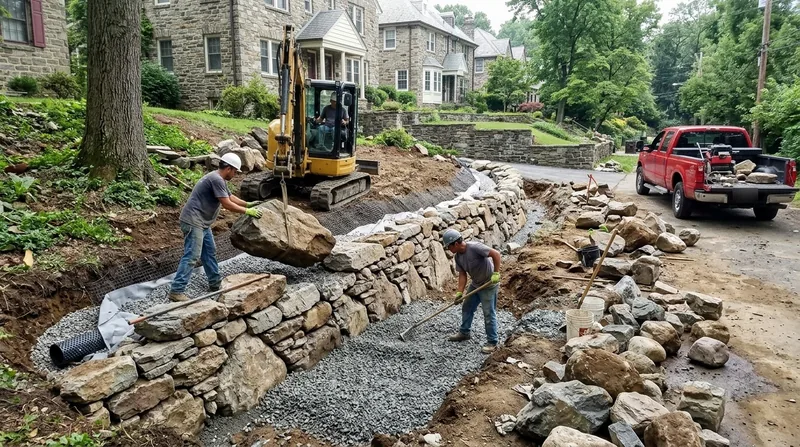




Boulder and natural stone retaining walls in Philadelphia blend durability with the authentic aesthetic that defines neighborhoods like Chestnut Hill, Roxborough, and Manayunk. Philadelphia's terrain splits sharply along the Fall Line: the rocky northwest sits on steep hillsides carved by the Wissahickon and Schuylkill, where 1890s stone twins rest on terraced lots held by mortared Wissahickon schist. The flat southeast sprawls across the Coastal Plain with sandy, silty clay soils and a high water table near the Delaware. Whether you're stabilizing a slope in Mount Airy or reinforcing a driveway cut in Media, natural stone walls handle freeze-thaw cycles, heavy nor'easter rain, and the seasonal swings of a mid-Atlantic climate. We install, repair, and replace boulder and stone walls using proper base preparation, drainage, and machine placement to ensure they last decades. Call (445) 278-5117 for a free estimate, or read on to understand why stone walls matter in this city.
Why Natural Stone Retaining Walls Matter in Philadelphia's Hilly Neighborhoods
Philadelphia's northwest quadrant sits on bedrock and rocky hillsides where gravity, frost heave, and water pressure work constantly against any wall. Freeze-thaw cycles crack concrete, erode mortar, and push poorly-drained walls outward. Natural stone walls, when built on solid footings with adequate drainage, resist these forces better than CMU or poured concrete because they flex slightly and shed water naturally. The grey Wissahickon schist look is not just aesthetic, it is proof that stone has held these slopes for over a century. In neighborhoods like Jenkintown, Lansdowne, and Chester, rotting railroad tie terraces and leaning CMU walls fail every winter. Boulder and stone walls, properly installed, stop that cycle.
- Natural stone resists freeze-thaw cracking better than poured concrete or hollow block.
- Proper drainage behind stone walls prevents hydrostatic pressure buildup that causes failure.
- Boulder and schist walls blend into Philadelphia's historic residential landscape.
- Stone walls hold steep slopes in the northwest and support level changes across the entire region.
- Machine placement on a compacted base ensures the wall settles evenly and lasts 50+ years.
When a wall is holding back soil on a slope or supporting a driveway surcharge, the stakes are high. Failure means erosion, property damage, and liability. Stone walls built to code do not fail.
Key info: Many Philadelphia jurisdictions require a permit for walls taller than roughly 4 feet measured from the footing, or when the wall supports a driveway, structure, or other surcharge. Check with your local building department before starting work. Setback and property-line rules vary by neighborhood and township. We handle permitting coordination and can connect you with the right department.
For more on repairing walls that are already failing, see our leaning and collapsed wall repair page.
How We Install Boulder and Natural Stone Walls in Philadelphia
Installation begins with site assessment. We measure slope grade, soil type, water flow patterns, and any surcharge (driveway, structure, or landscaping load). In neighborhoods like Conshohocken and Ardmore, where soils range from sandy to silty clay, drainage is critical. We excavate to undisturbed soil or bedrock, set a compacted gravel base, then place each stone on a level bed using a mini excavator or by hand, depending on wall height and access. Larger boulders go lower, smaller stones cap the top. We backfill with drainage rock and install a perforated drain pipe to shed water before it reaches the wall face. The result is a natural, durable wall that looks like it belongs on a Philadelphia hillside.
- We excavate to stable soil and prepare a level, compacted gravel foundation.
- Stones are placed with a slight batter (backward tilt) for stability and natural appearance.
- Drainage rock and perforated pipe behind the wall direct water away from soil and wall face.
- We backfill with native soil and compact in lifts to prevent settling.
- The finished wall is graded to shed surface water and integrates with your landscape.
From start to finish, the process respects Philadelphia's terrain and climate. A wall installed this way outlasts poor-quality poured concrete or leaning timber by decades.
Example: A homeowner in Roxborough had a 12-foot slope behind their rowhouse held by a rotting railroad tie wall. We removed the ties, set a proper base, installed a 14-foot boulder wall with drainage, and planted native shrubs on top. The wall has not moved in three years, and the property is now stable and protected from the spring snowmelt that used to flood the basement.
For details on drainage solutions that work alongside stone walls, visit our retaining wall drainage page.
| Approach | Description | Best for |
|---|---|---|
| Dry-laid Boulder Wall | Large boulders stacked without mortar, set on a gravel base with drainage behind. | Slopes, aesthetic appeal, areas where slight movement is acceptable, Philadelphia northwest. |
| Mortared Stone Wall | Stones set in mortar for a tighter, more formal appearance, often used to match historic walls. | Repair or replacement of existing mortared walls, formal gardens, retention of fine-grained stone. |
| Wissahickon Schist Veneer | Thin grey schist pieces faced over a concrete or block base for historic character. | Matching 1890s-1930s rowhouse terraces, heritage neighborhoods like Chestnut Hill and Manayunk. |
| Machine-placed Boulder Wall | Excavator-placed boulders on engineered base, fastest for tall or heavy-load walls. | Driveway support, tall slopes, sites with good equipment access, new construction. |
Boulder and Natural Stone Walls Cost in Philadelphia: What to Expect
Natural stone retaining walls in Philadelphia start at $25 per square foot for simple dry-laid boulder walls on stable ground with good access. That baseline assumes a wall 4 to 6 feet tall, straightforward slope, and no major obstacles. Cost rises when you factor in site challenges: steep terrain in Roxborough or Chestnut Hill, poor soil that requires deeper footing, high groundwater in the southeast, or a wall supporting a driveway or structure that triggers engineered design and permitting. A mortared schist wall matching a historic 1890s rowhouse in Jenkintown may run $40 to $50 per square foot. A tall boulder wall on a steep slope with heavy drainage work can exceed $60 per square foot. The best approach is to get two or three on-site estimates. A free estimate shows you exactly what the site requires and why the price lands where it does.
For a full breakdown of pricing across all our services, visit our pricing page. We also offer financing options and can discuss payment terms when you call (445) 278-5117.
What to Look for When Hiring a Boulder and Natural Stone Wall Contractor Near Philadelphia
Choosing the right contractor is as important as choosing the right material. A poorly installed stone wall will fail within a few years, costing you far more in repairs or replacement. Start by verifying that the contractor is licensed and insured in Pennsylvania and holds liability and workers compensation coverage. Ask for references from jobs in your neighborhood or similar terrain. Check whether the contractor pulls permits and coordinates with your local building department, especially for walls over 4 feet or supporting a surcharge. If your property is in an HOA or historic district, confirm that the contractor understands local design guidelines. Finally, get a written scope of work that specifies base depth, drainage details, stone type, and cleanup. Avoid contractors who skip site visits, quote over the phone, or refuse to pull permits.
- Verify Pennsylvania contractor license and current liability and workers compensation insurance.
- Request references from similar projects in Philadelphia, Norriton, or Media.
- Confirm the contractor will pull permits and coordinate with the local building department.
- Ask for a detailed written estimate that includes base preparation, drainage, and stone sourcing.
- Ensure the contractor understands HOA rules and historic district guidelines if they apply.
A qualified contractor will spend time on-site, explain the drainage strategy, and stand behind their work with a warranty. That diligence protects your property and your investment.
Ready to move forward? Contact us for a free estimate. We serve Philadelphia, Norriton, Conshohocken, Chester, Media, and surrounding areas. Call (445) 278-5117 or fill out our online form for a response within 24 hours.
Boulder & Natural Stone Walls in Philadelphia: Pricing Guide
| Service | Price | Details |
|---|---|---|
| Simple boulder wall, 4 to 6 feet tall | Starting at $25/sq ft | Dry-laid stones on stable ground with good equipment access and straightforward drainage needs. |
| Mortared or schist veneer wall | Starting at $40/sq ft | Stones set in mortar or thin schist veneer to match historic Philadelphia rowhouse terraces and formal design. |
| Tall or complex wall with heavy drainage | Starting at $50/sq ft | Steep slopes, poor soil requiring deeper footing, high groundwater, or wall supporting driveway or structure. |
| Large-scale or engineered project | On estimate | Multi-tiered walls, tall retaining structures, or sites requiring professional engineering and detailed site survey. |
| Free estimate | No charge | On-site assessment, written scope of work, and pricing within 24 hours, no obligation to book. |
Indicative pricing, the exact cost depends on square footage, finish, and site access. Free personalized estimate within 24h at (445) 278-5117.


