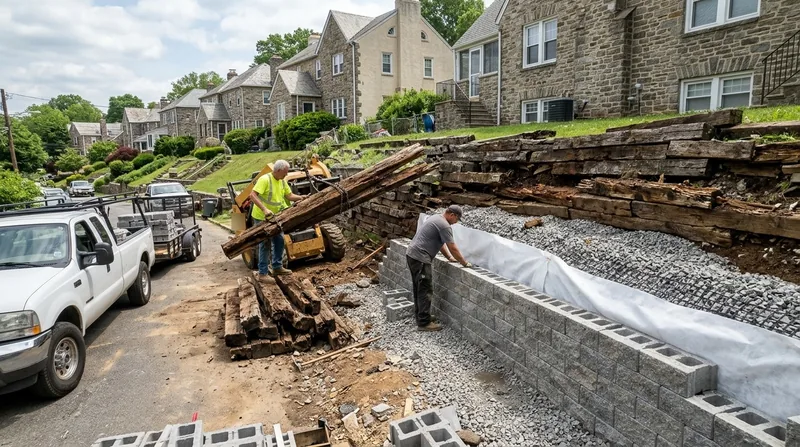




Railroad Tie Wall Replacement in Philadelphia is one of the most common retaining wall jobs we handle across the city and surrounding communities. Hundreds of homes built in the 1970s and 1980s, from Roxborough to South Philadelphia, were finished with creosote-treated railroad tie terraces that held back soil on steep lots and driveway cuts. Those ties are now rotting, leaning, or collapsing outright. Freeze-thaw cycles, moisture infiltration, and decades of ground pressure have left them structurally compromised. We remove the failed ties, haul away the treated wood safely, rebuild with segmental block, poured concrete, or natural stone, and install proper drainage so your new wall stays solid for 30+ years. If your yard is sloping, your driveway is cracking, or you see a wall tilting toward your house, call us at (445) 278-5117 for a free estimate.
Why Railroad Tie Wall Replacement Matters in Philadelphia
Philadelphia's terrain splits sharply at the Fall Line. Northwest neighborhoods like Chestnut Hill, Mount Airy, and Roxborough climb rocky slopes cut by the Wissahickon and Schuylkill valleys, where 1890s stone twins and rowhouses sit on steep terraced lots held by mortared schist and poured concrete. Southeast Philadelphia, the river wards, and the postwar Northeast sit on sand, silty clay, and old fill with a high water table near the Delaware. Everywhere in this city, front-yard CMU walls, driveway cuts, and rotting railroad tie terraces are failing under the same pressure: freeze-thaw in winter, clogged drainage weeps, summer cloudbursts, and nor'easter rain that saturates soil and pushes walls forward. A leaning or bulging railroad tie wall is not a cosmetic problem. It signals that the wall is losing its grip on the soil behind it.
- We extract creosote-treated railroad ties and dispose of them according to environmental regulations, eliminating toxic wood from your yard.
- We excavate failed walls to the footing, inspect the base for frost heave or subsidence, and correct drainage problems that caused the original failure.
- We rebuild using segmental retaining wall block, poured concrete, or natural stone, anchored to a stable gravel base with proper backfill and weep holes.
- We grade and slope the backfill away from the new wall so water runs off instead of pooling behind it.
A properly installed replacement wall stops erosion, protects your foundation, and restores usable yard space.
Key info: Walls above roughly 4 feet from the footing, or walls that support a driveway or structure, often require a permit from your local building department. In Philadelphia, Norristown, Ardmore, and Media, setback and property-line rules vary. We verify requirements with your municipality and handle permit coordination as part of the job.
For more detail on what a complete wall replacement involves, see our full retaining wall replacement service page. You can also review Philadelphia's permit requirements for walls and site work.
How We Execute Railroad Tie Wall Replacement in Philadelphia
The work starts with a site visit and measurement. We assess the wall height, the slope behind it, soil conditions, and what utilities or structures are nearby. We confirm whether a permit is required and what the local building department expects. Once you approve the estimate, we schedule the job and show up with a crew, a dumpster, and the equipment needed to remove the old wall safely and rebuild it to code.
- We mark the work area, protect adjacent plants and structures, and position equipment for safe access.
- We excavate the failed railroad tie wall from top to bottom, separating the treated wood for disposal and salvaging any clean fill or gravel.
- We inspect the footing and subgrade, correct any drainage or settlement issues, and compact the base.
- We install a new gravel drainage layer, then build the new wall using your chosen material, block by block or course by course.
- We backfill with clean gravel, install weep holes or a perforated drain pipe, and grade the surface to shed water away from the wall.
- We clean up, haul away all debris, and leave your yard ready to use.
Most jobs in Philadelphia take 2 to 5 days depending on wall length and height. We work systematically so your property stays safe and accessible.
Example: A homeowner in Lansdowne had a 40-foot-long, 4-foot-tall railroad tie wall holding back a slope behind their house. The ties were separating, water was pooling on the uphill side, and the wall was leaning outward. We removed the ties over two days, installed a gravel base and weep holes, and rebuilt with segmental block. The new wall is vertical, drains properly, and the homeowner regained confidence in their yard.
For information on our retaining wall drainage solutions, which are critical to preventing future failures, visit that service page.
Methods and Materials for Railroad Tie Wall Replacement
You have three main options for rebuilding a failed railroad tie wall. Each has different costs, lifespans, and appearances. We help you choose based on your budget, the wall's height and length, and what fits your home's style.
| Approach | Description | Best for |
|---|---|---|
| Segmental Retaining Wall (SRW) Block | Interlocking concrete units stacked and set back slightly for stability. No mortar needed. Clean, modern appearance. Lifespan 40+ years. | Most Philadelphia jobs. Affordable, durable, easy to repair a single unit if needed. |
| Poured Concrete Retaining Wall | Monolithic concrete stem cast on a footing, reinforced with rebar. Smooth or textured finish. Lifespan 50+ years. | Tall walls, tight spaces, or when a seamless appearance is desired. Higher upfront cost but minimal future maintenance. |
| Natural Stone or Boulder Wall | Mortared Wissahickon schist, fieldstone, or stacked boulders. Matches the historic character of Northwest Philadelphia. Lifespan 50+ years with proper drainage. | Historic homes in Chestnut Hill, Roxborough, or Manayunk. Higher cost but blends seamlessly with existing architecture. |
| Timber Retaining Wall (Non-Creosote) | Pressure-treated or naturally rot-resistant wood (cedar, redwood) set behind a concrete or gravel base. Warm, rustic appearance. Lifespan 15 to 25 years. | Short walls (under 3 feet) in yards where wood aesthetics are preferred. Not recommended for high-traffic or high-load applications. |
We recommend segmental block or poured concrete for most Philadelphia jobs because they handle our climate (freeze-thaw, moisture, high water table) without degradation and require minimal upkeep.
Railroad Tie Wall Replacement Cost in Philadelphia: What to Expect
The cost of railroad tie wall replacement in Philadelphia typically starts at $35 per square foot for segmental block walls of moderate height on accessible sites. That means a 40-foot-long, 4-foot-tall wall would run roughly $5,600 to $7,000 before permits and site-specific variables. Poured concrete walls cost more (often $50 to $75 per square foot) because of formwork and curing time. Natural stone walls can exceed $100 per square foot due to material and labor intensity. Height, length, soil conditions, drainage requirements, access, and material choice all move the price up or down.
Other factors that affect cost include:
- Wall height: taller walls require deeper footings, more material, and often engineering or permits.
- Soil conditions: soft, wet, or fill soil may need additional base preparation or stabilization.
- Access: if equipment can't reach the site easily, labor and machinery costs rise.
- Drainage complexity: if the old wall failed due to severe water issues, installing a proper drainage system adds cost but prevents future failure.
- Local permits: engineered drawings for tall walls or walls supporting structures add $500 to $2,000.
The best way to know the cost for your wall is to get a free, no-obligation estimate. Call us at (445) 278-5117 or visit our pricing page for more detail on what moves costs up or down. We always compare our price to at least one other qualified contractor so you know you're getting fair value.
Railroad Tie Wall Replacement Near Me: What Philadelphia Homeowners Should Know When Hiring a Contractor
Hiring the right contractor for your railroad tie wall replacement is just as important as choosing the material. A poorly executed replacement will fail again in 5 to 10 years. A well-built wall lasts 40+ years. When you're evaluating contractors in Philadelphia, Conshohocken, Media, or surrounding areas, ask these questions and verify these facts before signing a contract.
- Confirm the contractor holds a valid Pennsylvania general contractor license and carries liability and workers' compensation insurance.
- Request references from at least three recent projects in Philadelphia or similar terrain, and call them to ask about the quality, timeline, and cleanup.
- Ask whether the contractor will verify permit requirements with your local building department and handle the application if needed.
- Get written estimates from at least two contractors so you can compare scope, materials, timeline, and price side by side.
- Check that the contractor explains the drainage plan and why it matters for preventing future failure.
- Verify that the contract includes a cleanup schedule and a warranty on the work (typically one year minimum).
Don't hire based on price alone. The cheapest estimate often means shortcuts in drainage, footing depth, or backfill compaction that will cost you thousands in repairs later. Contact us today for a free estimate and a straightforward conversation about your wall.
Railroad Tie Wall Replacement in Philadelphia: Pricing Guide
| Service | Price | Details |
|---|---|---|
| Segmental Block Wall Replacement | Starting at $35/sq ft | Interlocking concrete block on prepared base with gravel backfill and weep holes, most common choice for Philadelphia residential walls |
| Poured Concrete Wall Replacement | Starting at $50/sq ft | Reinforced concrete stem with footing, formwork, and finish; higher cost offset by durability and seamless appearance on tall or tight-space walls |
| Natural Stone Wall Replacement | Starting at $75/sq ft | Mortared schist, fieldstone, or boulders matching historic Philadelphia architecture; material and labor intensive but blends with existing masonry |
| Site-specific or complex jobs | On estimate | High water table, poor soil, significant grade change, or multiple tiers require site inspection and engineered design before pricing |
| Travel and permits | Included and handled | No separate mileage fee within Philadelphia and surrounding service areas; permit coordination and local department liaison included in scope |
| Free estimate | No obligation | Call (445) 278-5117 for site visit, measurement, material consultation, and written quote within 24 hours |
Indicative pricing, the exact cost depends on square footage, finish, and site access. Free personalized estimate within 24h at (445) 278-5117.


