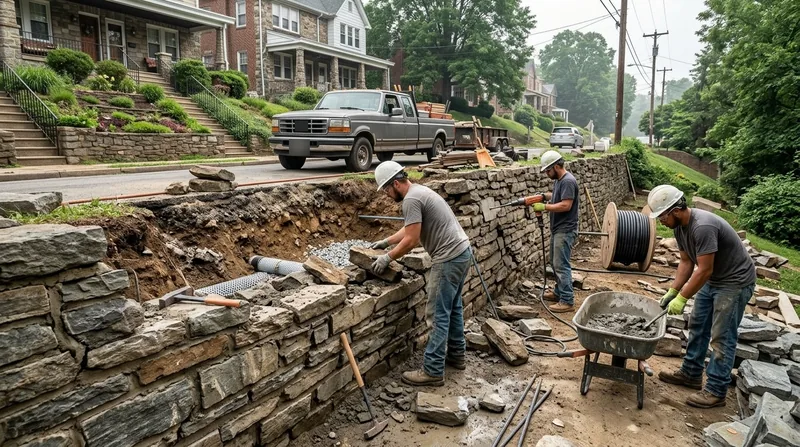




Retaining Wall Repair in Philadelphia is not a luxury, it's an urgent fix for the thousands of homeowners whose walls are leaning, cracking, or heaving under Philadelphia's brutal freeze-thaw cycles and heavy spring rains. From the steep, schist-lined terraces of Chestnut Hill and Roxborough to the flat sandy lots of South Philadelphia and Northeast rowhouse neighborhoods, failing retaining walls threaten foundations, driveways, and property lines. Whether your wall is a 1920s mortared stone structure on a Wissahickon hillside, a rotting railroad tie terrace holding back a garage cut, or a crumbling CMU block wall in front of a Northeast rowhouse, the failure mode is almost always the same: water gets behind the wall, frost heave pushes it forward, weep holes clog, and gravity does the rest. We stop that failure before collapse happens, using drainage correction, tieback anchors, and targeted stone or block rebuilds that hold the slope and protect your property.
Why Retaining Wall Repair Matters in Philadelphia's Freeze-Thaw Climate
Philadelphia's winter is not gentle. Temperatures swing 30 degrees in a single day, water freezes and thaws in soil behind your wall, and every cycle pushes the structure forward a fraction of an inch. Add the nor'easters that dump 2 to 3 inches of rain in an afternoon, and you have the perfect recipe for wall failure. A leaning wall is not cosmetic, it signals that soil pressure is winning, and without intervention, collapse follows within months. Early repair saves thousands in foundation damage, driveway replacement, and emergency rebuilding.
- We identify the root cause: clogged drainage, frost heave, inadequate backfill, or surcharge load from a structure or driveway above.
- We correct water management first, installing or clearing weep holes, French drains, and gravel backfill to remove hydrostatic pressure.
- We stabilize leaning or bowing walls with tieback anchors, rods, or cables anchored deep into stable soil or bedrock.
- We rebuild sections of mortared stone or block that have lost integrity, using matching materials and proper drainage details.
- We address settlement and heave by re-leveling or partial reconstruction where the existing footings have failed.
Early action stops a $3,000 repair from becoming a $25,000 collapse and foundation fix.
Key info: Philadelphia's Building Code requires a permit for most walls over 4 feet tall, or any wall supporting a surcharge such as a driveway or structure. Setback and property-line rules vary by neighborhood. Always verify with your local Building Inspection District before work begins. More details at City of Philadelphia Permits Office.
How We Repair Retaining Walls in Philadelphia: Our Process
Every repair starts with understanding why the wall failed. We inspect the wall face, check for leaning or bowing, look for cracks in mortar joints or block, test soil moisture behind the wall, and confirm whether the footing is still sound. In Philadelphia's dense neighborhoods, we also assess tree roots, utility lines, and proximity to neighboring properties. Once we know the failure mode, we build a repair plan that stops the problem at its source.
- We excavate carefully behind and beside the wall to expose the footing, assess soil conditions, and confirm drainage status.
- We install or repair drainage: clearing weep holes, laying perforated drain pipe, and backfilling with clean gravel to remove water pressure.
- We install tieback anchors, helical anchors, or steel rods if the wall is leaning; these anchor into stable soil or bedrock deep behind the wall.
- We rebuild failed sections of mortared stone or block, matching materials, color, and mortar type to the original wall.
- We re-compact backfill, test drainage, and confirm the wall is level and stable before final inspection.
Most repairs in Philadelphia take 3 to 7 days, depending on wall size, access, and how much of the structure needs rebuilding.
Local example: A 1930s mortared schist retaining wall in Roxborough that was leaning 4 inches forward had clogged weep holes and tree roots pushing the footing. We excavated, installed a French drain, anchored the wall with stainless steel rods, and rebuilt the upper 3 courses of stone. The wall is now level and has been stable for five years. See our leaning and collapsed wall repair service for more on this approach.
Retaining Wall Repair Methods and Materials
Philadelphia's walls come in many materials and ages. A 1890s mortared Wissahickon schist wall on a Chestnut Hill lot requires different repair than a 1970s poured concrete wall or a 1950s railroad tie terrace. The repair method depends on the wall type, the severity of failure, budget, and whether you want to match the original look.
| Approach | Description | Best for |
|---|---|---|
| Drainage correction | Clear clogged weeps, install French drain, re-grade backfill, remove standing water. | Leaning walls caused by hydrostatic pressure; first step in almost every repair. |
| Tieback anchors | Install stainless steel rods or cables anchored into stable soil or bedrock behind the wall; resist forward tilt. | Walls leaning 2 to 6 inches; avoids full rebuild when footing is still sound. |
| Partial rebuild | Remove failed upper courses, rebuild with matching stone or block, reset mortar joints. | Mortared stone walls with cracked or missing mortar; preserves historic appearance. |
| Full reconstruction | Remove entire wall, excavate and reset footing, rebuild with new or salvaged materials, install modern drainage. | Severely leaning or collapsed walls; failed footings; major slope stabilization. |
| Helical anchors | Screw anchors installed deep into soil; resists both forward tilt and settlement. | Walls on sandy or silty clay soils near the Coastal Plain; high water table areas. |
Retaining Wall Repair Cost in Philadelphia: What to Expect
Repair costs in Philadelphia start at $1,500 for minor drainage work on a small wall and climb to $8,000 to $15,000 or more for a wall requiring significant anchoring or partial rebuild. The main cost drivers are wall length, height, access, how much of the structure needs work, and whether the footing is intact. A 20-foot wall with clogged drainage and mild leaning might cost $2,500 to $4,000. A 40-foot wall requiring tieback anchors and 15 feet of stone rebuild could run $8,000 to $12,000. We always provide a detailed estimate after an on-site inspection, and we recommend getting 2 to 3 estimates to understand the scope and price range. See our pricing page for a full breakdown by job type.
Factors that move the cost up include tree roots requiring removal, utilities near the wall, poor soil requiring deeper anchors, and walls in tight spaces like between two rowhouses where equipment access is limited. We also factor in permit costs if your wall exceeds local height thresholds or supports a driveway. Getting the repair done sooner rather than later almost always saves money, a wall that collapses costs 5 to 10 times more to fix.
Retaining Wall Repair Near Me: What Philadelphia Homeowners Should Know When Hiring
Choosing a retaining wall contractor is not the same as hiring a general contractor. You need someone who understands soil mechanics, drainage, local building codes, and the specific challenges of Philadelphia's geology. Before you hire, ask for proof of licensing and insurance, get at least two other estimates for comparison, and check references from recent projects in your neighborhood. If your wall is in a historic district or subject to an HOA, verify that the contractor understands those restrictions and can work within them. Also ask whether your repair requires a permit and whether the contractor will handle the Building Inspection District paperwork. We carry full general liability and workers' compensation insurance, and we're familiar with Philadelphia's permit process for every neighborhood from Chestnut Hill to Chester.
- Verify the contractor holds a current Philadelphia business license and general contractor license if required by scope.
- Request a Certificate of Insurance showing general liability coverage of at least $1 million and workers' compensation.
- Ask for three references from similar walls repaired in the past two years in Philadelphia or nearby areas.
- Confirm whether the contractor handles permits or if you need to pull them yourself through your Building Inspection District.
- Get a written estimate that breaks down labor, materials, drainage work, anchors, and any permit or engineering costs separately.
- Ask about warranty: most repairs should carry at least a one-year warranty on labor and materials.
We offer a free estimate and respond within 24 hours. Call us at (445) 278-5117 or contact us online to schedule an inspection and get a detailed proposal.
Retaining Wall Repair in Philadelphia: Pricing Guide
| Service | Price | Details |
|---|---|---|
| Drainage correction and minor repair | Starting at $1,500 | Clearing weeps, installing French drain, re-grading backfill, minor pointing. Walls under 25 feet with no anchoring needed. |
| Tieback anchors and stabilization | Starting at $3,500 | Installation of stainless steel rods or cables anchored into stable soil. Includes excavation, anchors, and testing. Per anchor or per wall. |
| Partial rebuild of mortared stone or block | Starting at $4,500 | Removal and rebuild of upper courses, matching materials, mortar pointing, drainage work. Cost varies by height and length of section rebuilt. |
| Full wall reconstruction | On estimate | Complete removal, footing reset, full rebuild with new or salvaged materials, modern drainage. Requires on-site inspection and soil testing. |
| Travel and estimate | Free | No charge for on-site evaluation or estimate in Philadelphia and surrounding service areas. 24-hour response time guaranteed. |
Indicative pricing, the exact cost depends on square footage, finish, and site access. Free personalized estimate within 24h at (445) 278-5117.


