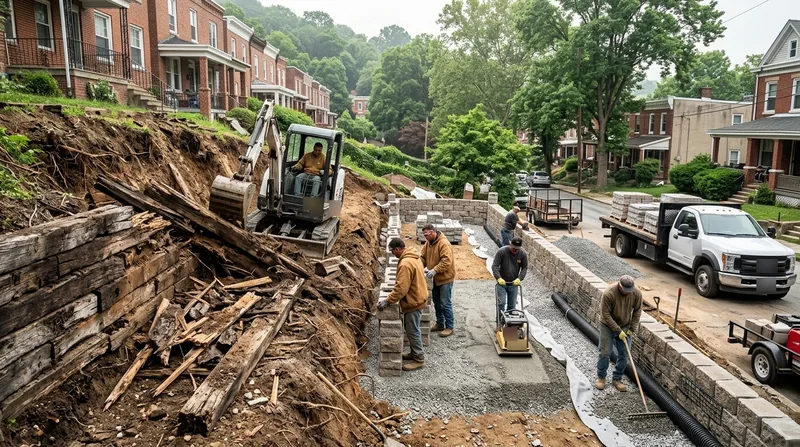




Retaining Wall Replacement in Philadelphia solves a problem that cuts across the entire region: walls fail. In the northwest hills of Chestnut Hill, Mount Airy, and Roxborough, 1890s and 1930s stone terraces mortared from Wissahickon schist crack and lean under freeze-thaw cycles and the weight of rowhouses above them. In South Philadelphia and the Northeast, crumbling CMU block walls, rotting railroad tie terraces, and poured concrete barriers collapse from frost heave, clogged drainage, and the region's punishing summer cloudbursts and nor'easter rains. When a wall fails, it threatens your foundation, driveway, and slope stability. We remove the failed structure completely, haul it away, install modern drainage, and rebuild with engineered materials rated for Philadelphia's climate and soil. The result is a wall that holds.
Why Retaining Wall Replacement Matters in Philadelphia's Steep and Flat Neighborhoods
Philadelphia's geography splits the failure problem into two zones. In the northwest, the Fall Line creates steep lots where original stone and concrete walls have been in service for 80 to 130 years. Freeze-thaw action, root pressure, and the weight of structures above them push them past their design life. In the southeast, the flat Coastal Plain and high water table create different stresses: saturated soil, frost heave, and poor drainage cause CMU walls and old timber terraces to bow, crack, and collapse. A failed wall is not a cosmetic issue. It can undermine your foundation, crack your driveway, destabilize your slope, and create liability. Replacing it protects your property and restores usable land.
- We demolish the entire failed wall, including footings, and remove all debris from the site.
- We install new subsurface drainage to prevent water buildup and frost heave in future seasons.
- We rebuild with engineered block, poured concrete, natural stone, or timber to match your lot and budget.
- We verify setback, property-line, and permit requirements with your local building department before we start work.
Replacing a failed wall is the only way to restore full slope stability and prevent further damage to your home or yard.
Key info: Philadelphia and surrounding communities like Media, Jenkintown, and West Chester all experience the same freeze-thaw failure pattern. Most walls fail between November and April when soil moisture, frost heave, and thermal stress peak. If your wall is leaning, cracked, or has missing mortar or blocks, replacement is usually the right call.
For more on the full range of wall issues we handle, see our page on leaning and collapsed wall repair.
For permit requirements in your jurisdiction, contact your local building department. Pennsylvania does not have a statewide wall permit threshold, so rules vary by municipality. Most jurisdictions require a permit for walls above 4 feet measured from the footing, or when a wall supports a driveway or structure. See Philadelphia's Department of Permits and Licenses for city-specific guidance.
How We Replace a Failing Retaining Wall in Philadelphia
Replacement is a phased process that begins with a site visit and ends with a wall that will serve your property for 30 to 50 years. We start by assessing the failed structure, identifying why it failed (poor drainage, frost heave, structural overload, age), and determining what material and design will work best on your lot. We then obtain any required permits, schedule demolition, and execute the rebuild. Throughout the job, we manage drainage, compact soil properly, and ensure the wall is set to the correct height and grade.
- We visit your property, photograph the wall, measure its dimensions, and assess soil and drainage conditions.
- We provide a written estimate that includes demolition, haul-away, new drainage, and the cost of the new wall material and labor.
- We handle all permit applications and coordinate with your local building department.
- We schedule and execute the demolition, removing the old wall and all debris from your site.
- We dig out the footing, install new subsurface drainage (perforated pipe and gravel), and prepare the base for the new wall.
- We build the new wall to engineered specifications, backfill with compacted soil, and finish the grade.
From first visit to completion, most residential replacements take 2 to 4 weeks depending on wall size, access, and weather.
Local example: A homeowner in Ardmore had a 35-foot-long, 6-foot-tall mortared stone wall that was leaning inward and cracking at the corners. We removed it in two days, installed 4-inch perforated drainage, and rebuilt it in engineered block with a proper setback from the property line. The job took three weeks total and cost $8,400. The wall now handles the slope and winter freeze cycles without issue.
See our drainage solutions page for details on how proper water management prevents future failures.
Retaining Wall Replacement Methods and Materials
| Approach | Description | Best for |
|---|---|---|
| Engineered Block (SRW) | Segmental retaining wall blocks, interlocked and set on compacted base with geogrid reinforcement. | Most residential jobs; fast installation, durable, cost-effective, handles freeze-thaw cycles well. |
| Poured Concrete | Reinforced concrete wall cast in place or precast panels, monolithic structure. | Large walls, high loads, tight spaces, and where a smooth finished face is desired. |
| Natural Stone (Boulder/Rock) | Large stones or boulders set in gravel, dry-stack or mortared depending on height and slope. | Aesthetic appeal, blends with landscape, works well on northwest Philadelphia's historic lots. |
| Timber (Pressure-Treated or Composite) | Dimensional lumber (6x6, 8x8) set on a gravel base with tie-backs for stability. | Lower walls (under 4 feet), residential aesthetic, and when budget is tight. Requires annual inspection. |
Retaining Wall Replacement Cost in Philadelphia: What to Expect
Replacement cost in Philadelphia typically starts at $35 per square foot for a basic engineered block wall with proper drainage and labor. A 30-foot-long, 4-foot-tall wall (120 square feet) would run roughly $4,200 to $5,400 depending on access, soil conditions, and whether the old wall is mortared stone or rotted timber. Larger walls, complex drainage, natural stone, or poured concrete can push costs higher. The most common variables are wall height, length, material choice, site access (narrow lot or hillside), and whether the old wall includes a deep footing or tree roots that complicate demolition.
Getting multiple estimates is essential. Each contractor will assess drainage, soil bearing capacity, and local permit requirements differently. We provide a free, no-obligation estimate within 24 hours. Visit our pricing page for a detailed breakdown of material costs and labor ranges.
Winter jobs (November through March) sometimes cost 10 to 15 percent more because of shorter daylight, frozen ground, and weather delays. Spring and fall are the most cost-effective seasons for replacement work.
Retaining Wall Replacement Near Me: What Philadelphia Homeowners Should Know When Hiring a Contractor
Choosing the right contractor for wall replacement is as important as choosing the material. A poorly installed wall will fail again in 5 to 10 years. A properly built one will last 30 to 50 years. Start by verifying that your contractor is licensed and insured for retaining wall work in Pennsylvania. Ask for references from recent jobs in your neighborhood or similar terrain. Request a written estimate that breaks down demolition, drainage, material, and labor. Confirm that the contractor understands local setback and property-line rules and will handle permit applications. If your wall is near a neighbor's property, an HOA, or a historic district, clarify those requirements upfront.
- Verify that the contractor holds a current Pennsylvania home improvement license and carries liability and workers compensation insurance.
- Request at least two other estimates so you can compare scope, material choice, and price.
- Ask for references from three recent jobs and follow up with those homeowners about quality, timeline, and cleanup.
- Confirm that the contractor will obtain all required permits and coordinate with your local building department before starting work.
- Discuss drainage design in detail: proper water management prevents 90 percent of wall failures.
- Get a written contract that specifies start date, completion date, material specifications, warranty, and payment schedule.
A contractor who rushes through the estimate, avoids discussing drainage, or won't provide references is a red flag.
Ready to get started? Contact us for a free estimate at (445) 278-5117. We'll visit your site, assess the wall, and provide a detailed written proposal within 24 hours.
Retaining Wall Replacement in Philadelphia: Pricing Guide
| Service | Price | Details |
|---|---|---|
| Engineered Block Wall Replacement | Starting at $35/sq ft | Demolition, drainage, new block wall, and compacted backfill. Price varies with wall height, length, and site access difficulty. |
| Poured Concrete Wall Replacement | Starting at $45/sq ft | Includes formwork, reinforcement, concrete pour, drainage, and finish. Higher cost reflects material and labor intensity. |
| Natural Stone or Boulder Wall Replacement | Starting at $50/sq ft | Material sourcing, placement, and finish work. Cost depends on stone size, availability, and site terrain complexity. |
| Timber Wall Replacement | Starting at $25/sq ft | Pressure-treated or composite lumber, tie-backs, and drainage. Lower cost but requires periodic inspection and maintenance. |
| Complex or emergency replacement | On estimate | Large walls, multiple tiers, poor soil, or urgent stabilization require site assessment and engineered design before pricing. |
| Free estimate | No charge | Site visit, photographs, measurements, and written proposal provided within 24 hours at (445) 278-5117. |
Indicative pricing, the exact cost depends on square footage, finish, and site access. Free personalized estimate within 24h at (445) 278-5117.


